


Preferred Solution for Complementing Missing Teeth
Statistics show that 69% of adults aged 35 to 44 have lost at least one tooth due to an accident, gum disease, damaged root canal or tooth decay. Also, by the age of 74, 26% of adults lose all their permanent teeth.
Twenty years ago, these patients had no alternative but to use a fixed bridge or removable prosthesis to restore their ability to eat, speak properly, and smile. However, fixed bridges and removable prostheses are not a perfect solution and often bring some problems. Prostheses may shift or make annoying clicking noises while eating or talking. More importantly, fixed bridges often affect adjacent healthy teeth, and removable dentures can cause bone loss in the tooth or in the area where the teeth are missing. Recurrent caries, periodontal disease (gum disease) and other factors cause the early failure of fixed bridges. For these reasons, fixed bridges and removable dentures usually need to be replaced every seven to fifteen years.
Before and after dental implants
Currently, there is another option for patients who are missing permanent teeth. Dental implants are placed in the jawbone for long-term use by your oral and maxillofacial surgeon, rather than resting on the gum line like removable dentures or using adjacent teeth as fixed bridges. Made of titanium metal that fuses with the jawbone in a process called ‘osseo integration’, dental implants never slip or make embarrassing noises that indicate you have ‘dentures’ or rot like teeth holding fixed bridges. Since dental implants fuse with the jawbone, there is usually no bone resorption problem.
After more than 20 years of use, most dental implants first applied by your oral and maxillofacial surgeon in the United States still work with superior performance. More importantly, patients with these first dental implants are still satisfied that they made the right choice. Dental implants can last a lifetime if well cared for.
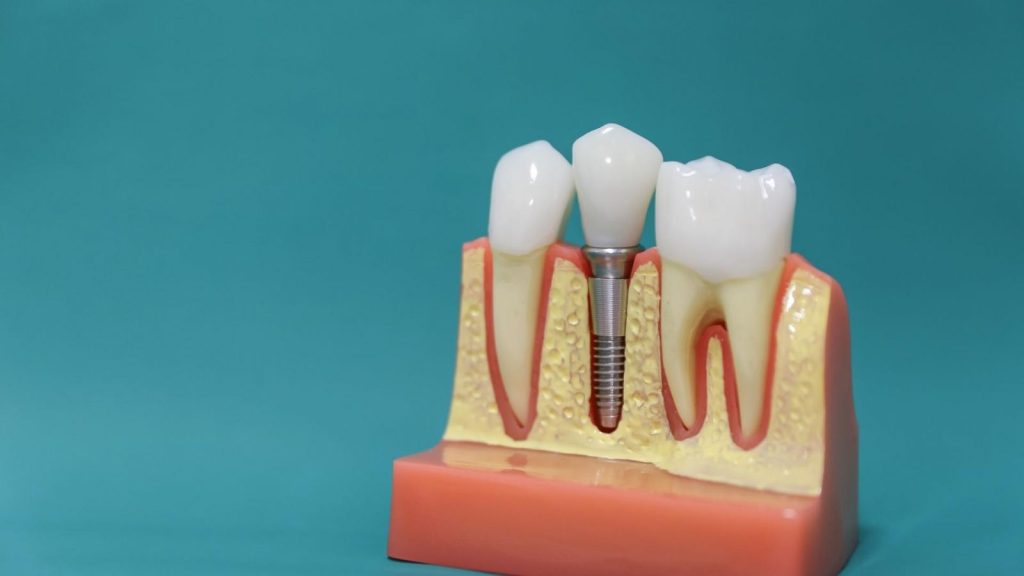
Anatomy of Dental Implants
Many people who are missing a tooth often opt for a bridge; however, the bridge may require the cutting of the adjacent healthy tooth; this may need to be fixed in the future. There is also an additional cost to replace one, two or more over the life of the bridge. Similarly, a removable partial denture can contribute to the loss of the adjacent tooth. Studies show that within five to seven years, 30% of teeth located near a fixed bridge or removable partial denture decay.
Fixed bridges may require shaping or cutting adjacent healthy teeth.
Bone is preserved by the presence of natural teeth or implants (a).
Bone loss occurs with tooth loss (b).
In addition, conventional dentures also contribute to bone loss in the area where the teeth are missing. The presence of natural teeth protects the jawbone as shown in picture (a). When a tooth is missing as in picture (b), the bone can wear and weaken and the oral and maxillofacial surgeon may need to graft the area to strengthen it for dental implants. When a dental implant is made to replace a missing tooth, the fusion of the implant and bone provides stability, just as a natural tooth does.
Even if you’re missing several teeth in the same area of your mouth, you can still enjoy the confidence and lifestyle benefits of dental implants. Your oral and maxillofacial surgeon places two or more dental implants, depending on the number of missing teeth. Teeth that replace your missing teeth are attached to implants to provide superior function and prevent bone loss. Implants act as a stable support that firmly clamps onto your replacement teeth and dentures to prevent shifting and bone loss.
With an overall success rate of approximately 95% and clinical trials spanning nearly 50 years, dental implants are often the best treatment option for replacing missing teeth.
Dental Implants Against Conventional Dentures
Implants can be used to replace a missing tooth for a natural feel and appearance.
In addition, two or more implants can act as a fixed support for more than one tooth.
Many patients who prefer dental implants report that they lead a much more comfortable and safe life than those using fixed bridges or removable dentures. Prostheses often cause patients to feel and look older than they are; When they swipe and click, they embarrass them in social situations and limit their enjoyment of everyday comfort food.
While patients count the benefits they get from dental implants, they say that the implants eliminate the daily hassle and discomfort caused by non-fitting dentures. Implants also allow their users to have a healthy and rich diet without experiencing the restrictions faced by prosthetic wearers. With a renewed sense of self-confidence, people are rediscovering the excitement of an active lifestyle shared with family and friends, and the chance to talk smoothly and comfortably with colleagues. For all these reasons, people who have dental implants often state that they feel better, look better and live better.
Dental implants are the product of teamwork.
Dental implants combine the highest qualities of modern science and technology, including a multidisciplinary team approach. A successful implant requires that all parties (the patient, the restorative dentist who makes the crown for the implant, and the oral and maxillofacial surgeons who surgically place the implant) follow a careful treatment plan. All members of the implant team are in close contact with each other so that everyone has a clear understanding of what needs to be done to meet the patient’s expectations.
As soon as the dental implant is decided, the team is formed. After a thorough examination, X-ray, and consultation with the patient and members of the implant team, the oral and maxillofacial surgeon surgically places the post or implant in the patient’s jaw. After the implants are fixed in the jaw, the restorative dentist prepares an upper and lower jaw mold. The mold is used to make the model on which dentures or crowns will be formed.
It continues for a long time after the implant and crown are placed. Follow-up examinations with the oral and maxillofacial surgeon and restorative dentist are critical and the treatment process is carefully planned. Both the oral and maxillofacial surgeon and the restorative dentist continue to work together to provide the highest level of post-treatment care.
